

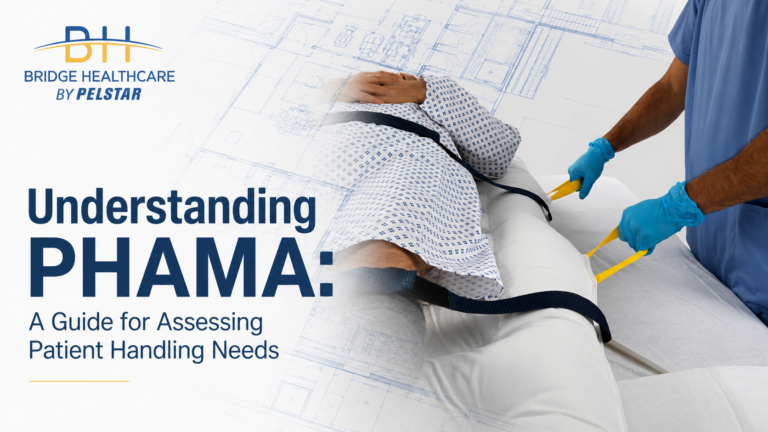
When a healthcare facility plans new construction or a renovation, a PHAMA (Patient Handling and Mobility Assessment) is often part of the project plan. It’s not just another compliance checkbox. Done well, a PHAMA shapes how a space is built, how equipment is stored, and ultimately how safely staff and patients move through the daily work of care.
What Is a PHAMA?
A PHAMA is an assessment conducted at the start of a construction or renovation project to help design teams incorporate the right patient handling and movement equipment into the care environment, including ceiling lifts, floor lifts, and other transfer equipment. Rather than adding this equipment as an afterthought, a PHAMA builds it into the design and construction process from the beginning.
The concept comes from the Facility Guidelines Institute (FGI), which maintains the Guidelines for healthcare facility design and construction used across the industry. PHAMA was first introduced through a white paper from the 2010 Health Guidelines Revision Committee, which made the case for moving away from manual patient handling. That case rests on three pillars: caregiver injury risk, patient outcomes, and the financial cost of manual handling to healthcare organizations. The paper also outlined how to conduct a PHAMA, how to design facilities that support safe patient handling and mobility (SPHM) equipment, and how to build the organizational and financial case for an SPHM program.
The Two Phases of a PHAMA
According to the FGI Guidelines, a PHAMA breaks down into two interdependent phases:
Phase 1: Needs Assessment. This phase identifies the appropriate patient handling and movement equipment for each specific patient care area, based on the population that area serves.
Phase 2: Design Requirements. This phase determines the space, structural, and other design requirements needed to accommodate that equipment and to support patients’ weight bearing and physical activity as part of their care.
Notably, the FGI Guidelines are clear that a PHAMA isn’t primarily a clinical assessment. Its real focus is the design and storage requirements that equipment decisions create, such as clearances needed for lift use, wider door openings for expanded capacity beds, and similar structural implications.
Why Equipment Needs Vary by Location
Patient populations differ from one care area to another, and the physical layout of each space differs too, so SPHM equipment recommendations need to be developed area by area rather than applied as a single facility wide standard. This ensures the type, size, weight capacity, and quantity of equipment in each space actually fits that space, and that adequate storage is planned close to where the equipment will be used.
A PHAMA should account for every area where patient handling, movement, or mobilization takes place, along with any associated toileting, bathing, or showering areas. That includes:
- Patient entrances, ambulance bays, reception areas, and admitting units
- Medical/surgical units
- Rehabilitation units
- Critical care units
- Spinal cord injury/traumatic brain injury units
- Labor/delivery, antepartum, and postpartum units
- Emergency department/urgent care
Matching Equipment to Patient Dependency Levels
Equipment recommendations are driven largely by the average dependency levels of the patient population in each area. To keep this manageable, patients are grouped by physical limitation rather than clinical acuity, into categories ranging from total dependence to extensive assistance, limited assistance, supervision, and full independence. The size, weight, and shape of individuals of size is another factor built into equipment selection, to make sure weight capacities and dimensions are appropriate.
Equipment decisions also account for the types of high risk patient handling and movement tasks staff will perform in each area, tasks that, without the right equipment, place significant biomechanical and postural stress on caregivers and carry real injury risk for both staff and patients.
How a PHAMA Supports a Broader SPHM Program
A PHAMA typically feeds directly into an organization’s safe patient handling and mobility (SPHM) program. SPHM programs go beyond injury prevention alone. They’re also built to improve patient outcomes through earlier, more frequent mobilization, and to reduce the costly adverse events that can result from manual handling.
This connection isn’t incidental. The American Nurses Association includes PHAMA related work in its own benchmarks for establishing an SPHM program, specifically calling out ergonomic design of the care environment and the selection, installation, and maintenance of SPHM technology as core components.
A PHAMA supports that broader program in a few concrete ways:
It gets the equipment and infrastructure right from day one. An SPHM program can only succeed if staff actually have the right lifts, slings, and transfer equipment within reach of where they need them, and if the building itself supports that equipment through adequate clearances, ceiling track, storage, and door widths.
It closes the gap between having equipment and actually using it. Access to SPHM technology alone doesn’t guarantee results. Nursing surveys have found that while most nurses report having access to SPHM equipment, a meaningfully smaller share use it consistently. Programs succeed when they pair the right equipment with three additional supports: visible management backing, ongoing staff training, and a system for tracking injuries so the organization can see whether the program is actually working. A PHAMA sets up the equipment side of that equation. The training, policy, and measurement pieces are what turn the equipment into a functioning program.
It reflects current best practice, not just a design formality. The updated FGI Guidelines place a stronger emphasis on mobilizing patients early and often, which is part of why the assessment was renamed from “Patient Handling and Movement Assessment” to “Patient Handling and Mobility Assessment.” That shift reflects a broader recognition in the field that safe patient handling and getting patients moving are connected goals, not separate initiatives.
Why a Facility Needs a PHAMA
A PHAMA gives the design team the information it needs to make equipment and space decisions before construction locks those decisions in. Without one, a facility risks ending up with clearances that don’t fit the lifts staff actually need, storage that’s inconveniently located, or equipment that doesn’t match the population it’s meant to serve. Build it in from the start, and the result is a facility designed around the realities of safe patient handling, for the people delivering care and the patients receiving it.
Where Bridge Healthcare Fits into a PHAMA
As facilities work through the PHAMA process, it’s worth considering not just overhead lifts but the full range of SPHM equipment that supports safe, efficient patient movement, including lateral transfer solutions. Bridge Healthcare’s product line, including BridgeAir™, SlideMate®, Gold Rollboard, and BridgeSTAR™, is designed to address the lateral transfer and repositioning tasks that make up a significant share of high risk patient handling activity. Factoring these products into the equipment and storage planning phase of a PHAMA helps ensure care areas are equipped not just for lifting, but for the full spectrum of moves, including transfers, repositioning, and mobilization, that staff perform every day.
Visit bridgehcusa.com to learn more about the wide portfolio of Safe Patient Handling products.
Sources
- Facility Guidelines Institute, “Offering a fresh look at patient handling,” HFM Magazine. Background on the PHAMA name change and the second edition’s added focus on SPHM business planning: https://www.hfmmagazine.com/articles/3797-offering-a-fresh-look-at-patient-handling
- Facility Guidelines Institute, FGI Bulletin #12. Additional background on the second edition update: https://fgiguidelines.org/fgi-bulletin/fgi-bulletin-12/
- ColoWrap, “3 Barriers to SPHM Program Implementation.” VHA injury rate reduction, Tampa General lift team results, and ANA equipment access/use survey data: https://www.colowrap.com/blog/sphm_barriers