
Every Transfer Counts: The Case for Safe Patient Handling in ASCs
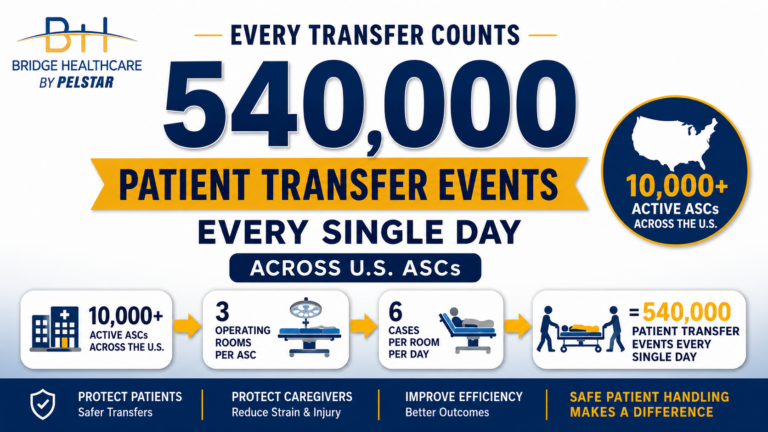
Over the past decade, Ambulatory Surgery Centers have become the primary setting for surgical care, now hosting more than 80% of all U.S. surgeries, and procedure volumes at ASCs are forecast to climb 21% over the next 10 years.* ASC procedures start with patient arrival and pre-op, then prior to the surgery the patient is transferred from their pre-op stretcher onto the operating room (OR) table. Once surgery is completed the patient is then transferred again onto their post-op recovery bed. Considering this workflow and using ASC data, it can be calculated that with 10,000 active ASCs across the U.S., each averaging 3 operating rooms performing 6 cases per day, the U.S. ambulatory surgery center industry performs an estimated 540,000 patient transfer events every single day.
Each patient transfer poses challenges and risks, both for patients and staff.
Patient Safety – During the transfer, particularly in post-op, patients are in a fragile state. Many ASC procedures involve surgery on limbs or the spine, meaning extra care is required during the transfer to protect incisions and spinal alignment. There may also be monitoring systems such as IV or electrode lines that cannot be dislodged or disrupted. Longer procedures also pose a risk for pressure injuries if weight bearing points are not offloaded properly.
Staff Safety – if the patient is unconscious during the transfer from the OR table to the recovery bed, the patient cannot help participate in the transfer. In this state the patient is limp and unresponsive, so their weight feels even heavier. And if the patient is awake, there is still great effort required to effectively transfer the patient. These transfers put excessive physical strain on staff and when performing this task several times a day it can lead to musculoskeletal injuries.
Despite these risks, manual patient handling remains the standard practice across most ASCs, even though a range of Safe Patient Handling products are available.
Safe Patient Handling products are designed to make patient movement physically easier for caregivers and provide patients with a safer transfer experience.
- Air-assisted Transfer Mattresses – mattress placed beneath a patient that inflates with air to create a near-frictionless surface.
- RollBoards – lightweight, foam-core placed beneath a patient to bridge the gap between two surfaces, such as a stretcher and an OR table, allowing staff to slide the patient across without lifting.
- Slide Sheets – low-friction fabric tube that is placed beneath a patient to reduce the resistance between the patient and the surface they are resting on.
- Turning Sheets and Wedges – used to turn and reposition a patient in bed without lifting, typically to relieve pressure on specific body contact areas.
- Fall Recovery Systems – air lifting device that enables a fallen patient to be raised from the floor in a safe and controlled manner.
How can ASC’s benefit from using Safe Patient Handling products?
- Staff Injury Reduction
Using assistive patient transfer products reduces the physical effort required to move the patient. Less effort means less strain on staff and less risk of workplace injury. Also, making each transfer easier for the caregivers will lead to less fatigue from performing several transfers each day.
- Patient Safety
A more controlled and smooth patient transfer can protect the patient’s surgical sites and spinal integrity. Using assistive devices also prevents the patient from experiencing a skin shear injury from friction. Wound care, such as support wedges, can prevent pressure injuries in high-risk areas of the body during lengthy surgical procedures.
- Workflow Efficiency & OR Throughput
Faster, more efficient transfers between surfaces can support OR throughput and room turnover. Utilizing assistive products also lowers workers’ compensation costs associated with staff lifting injuries and reduces risk of costly adverse events tied to patient falls or positioning errors.
Bridge Healthcare by Pelstar is the ideal partner for Ambulatory Surgery Centers and their Safe Patient Handling initiatives. Bridge Healthcare offers a range of high-quality products designed to reduce the risk of injury and enhance the efficiency of patient transfers, fall recoveries, and repositioning. If you would like to learn more about how Bridge products can help your ASC, please contact us at (800) 815-6615 or info@pelstarllc.com.
*Source: https://www.dialoghealth.com/post/ambulatory-surgery-center-asc-statistics