

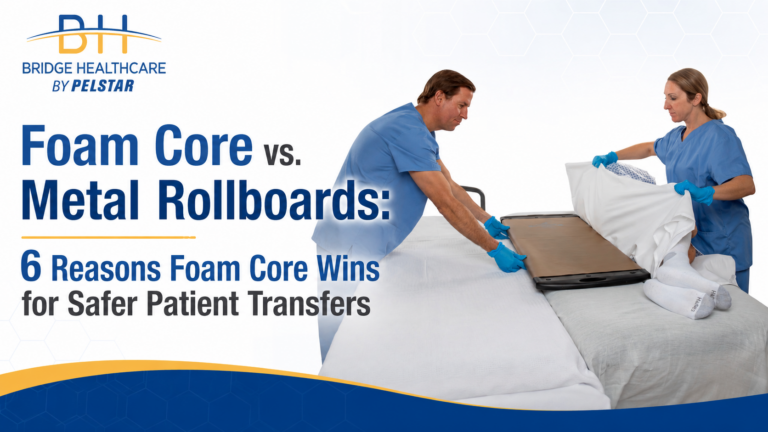
Moving a patient with limited mobility between surfaces — from a bed to a stretcher, for example — is one of the riskiest routine tasks in a healthcare setting. Done poorly, it can injure the caregiver’s back or shred the patient’s skin. Done well, it’s fast, controlled, and dignified. The equipment that makes the difference is the transfer board, and the material it’s made from matters more than most facilities realize.
How Transfer Boards Work
A transfer board bridges the gap between two surfaces so a patient can be slid across rather than lifted. Caregivers place a draw sheet under the patient and slide it — and the patient — along the board’s low-friction surface. That single change cuts the push/pull force caregivers need by up to 40%, which translates directly into fewer muscle strains and back injuries. It also protects patients by minimizing the skin friction and fall risk that come with manual lifts.
Metal Rollboards vs. Foam Core Rollboards
Most facilities choose between two designs. Metal rollboards are built from rigid, heavy-duty plastic with a row of metal rollers running the length of the board, functioning like a conveyor belt to reduce friction. Foam core rollboards use a lightweight, sturdy foam core wrapped in a durable outer layer that rotates around it, creating the same sliding action without the rigid hardware.
On paper, both designs solve the same problem. In daily use, the differences show up fast — in comfort, weight, safety, and where the board can go. Here’s how foam core rollboards compare.
1. Patient Comfort
Metal rollers can feel harsh against skin, especially for frail, elderly patients or those with fragile or sensitive skin — and a transfer is already an anxious moment for many patients. Foam core rollboards have a soft, smooth surface that’s more comfortable to slide across, and their lighter, lower-profile build feels far less intimidating than a large metal board. The result is a gentler, more dignified transfer experience.
2. Caregiver Safety
A transfer board reduces effort, but a heavy board introduces its own risk: staff can still pull a muscle just lifting a metal rollboard into place, and because metal boards are less effective at cutting friction, the physical strain of the transfer itself doesn’t disappear. Foam core rollboards are significantly lighter, so staff can lift and position them with less fatigue, and their low-friction fabric makes the actual transfer smoother and safer.
3. Ease of Use
When treatment is urgent, every second counts. A lightweight foam core rollboard can be placed under a patient quickly for a smooth, fast transfer, and it’s easy to hang on a wall hook between uses — a small detail that improves both workflow and storage. Metal rollboards, some weighing as much as 15 lbs, are slower to retrieve, carry, and position, adding strain and delay exactly when neither can be afforded.
4. Patient Safety
Any transfer board is safer than sliding a patient on bedsheets alone, which puts both caregiver backs and patient skin at risk. But not all boards protect skin equally. The smooth surface of a foam core rollboard lets the draw sheet glide easily, minimizing shear injuries. Metal rollboards, by contrast, can bruise skin where it contacts the hard rollers.
5. Department Versatility
Metal rollboards aren’t MRI safe, which rules them out of imaging environments entirely. Foam core rollboards’ non-metallic construction means they can travel anywhere in the facility, imaging suites included. They also come in a wider range of sizes and foldable options, compared to the one or two sizes typical of metal boards, making it easier to standardize one solution across the ER, radiology, and long-term care.
6. Infection Control
Some foam core rollboards add antimicrobial treatment to the outer layer and handles to help inhibit bacterial growth, and heat-sealed seams that close off places for germs to hide — features that are difficult to replicate on a board built around metal hardware.
The Bottom Line
Some type of transfer equipment is essential to protect both patients and staff during a move between surfaces — that much isn’t in question. What’s worth a closer look is which board does that job best. Weighed across comfort, caregiver safety, speed, patient protection, versatility, and infection control, the foam core rollboard comes out ahead of its metal counterpart on nearly every measure.
Pelstar LLC / Bridge Healthcare offers the McAuley Medical Gold Rollboards, engineered to deliver these advantages over traditional metal rollboards.
Learn more about the full line of McAuley Medical Gold Rollboards at bridgehcusa.com/goldroll-boards or call 1-800-815-6615.