

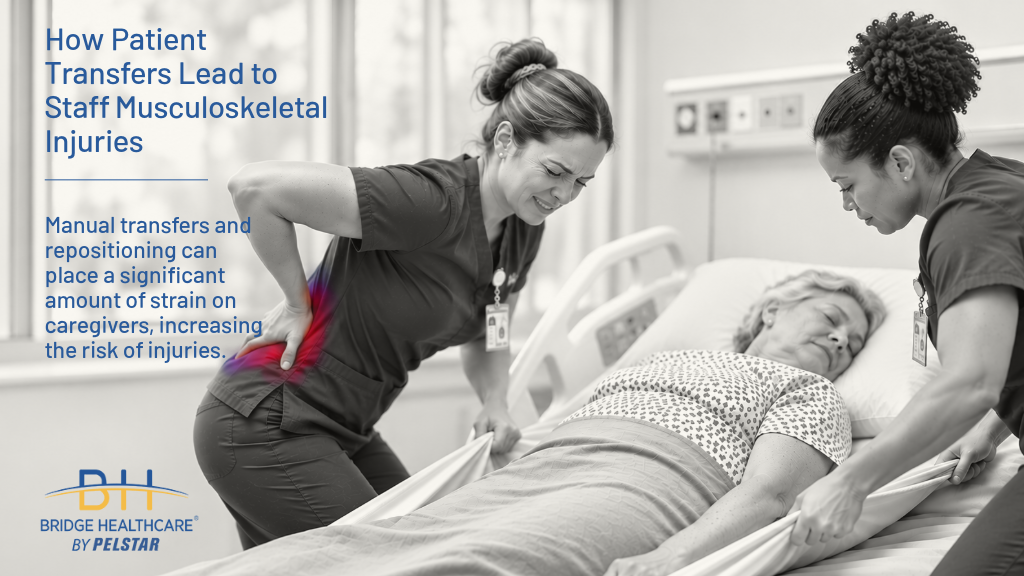
Moving patients is part of the job for nurses, nursing assistants, and therapists, and it is one of the most common ways they get hurt. Every lift, transfer, and boost in bed puts force on a caregiver’s back, shoulders, and joints. Over time, or in a single bad moment, that force can lead to a musculoskeletal injury that sidelines a caregiver for weeks or ends a career.
The numbers show how widespread the problem is. According to the U.S. Bureau of Labor Statistics, nursing assistants had 15,360 musculoskeletal disorder (MSD) cases in 2018, and MSDs made up 52 percent of their injuries that required time away from work. Earlier BLS data found nursing assistants were hurt by overexertion at a rate more than five times greater than all other workers. Understanding exactly how these injuries happen is the first step in preventing them.
Why Patient Transfers Are So Hard on the Body
Lifting a patient is very different from lifting a box. Patients are heavy, shaped awkwardly, and can’t be held close to the body. They may shift their weight, lose their balance, or resist without warning. Caregivers often work over a bed, reach across a wheelchair, or bend in a tight bathroom, which puts the spine and shoulders in their weakest positions.
NIOSH research safety engineer Thomas Waters applied the NIOSH Lifting Equation to patient handling and found that the recommended maximum for most manual patient lifts is about 35 pounds. That limit assumes ideal conditions. It drops when the caregiver has to reach with extended arms, lift near the floor, twist, kneel, or work in a cramped space. For comparison, the leg of a 250-pound patient alone weighs about 39 pounds. Even two caregivers sharing a 90-pound load each exceed the limit.
The risk also adds up. A caregiver may perform dozens of transfers and repositions in a shift, and each one adds stress to tissues that may not have recovered from the last.
Back Injuries: Herniated Discs and Lumbar Strains
The lower back takes the most force during a lift, which makes it the most commonly injured area for caregivers.
Herniated discs. The spine’s vertebrae are cushioned by discs with a tough outer ring and a soft, gel-like center. Bending forward while lifting a heavy load squeezes the front of the disc and pushes the center toward the back. Adding a twist, like turning to move a patient from a bed to a wheelchair, increases that pressure. Over time, or during one heavy strain, the outer ring can crack and the center can bulge or leak out. If it presses on a nearby nerve, the caregiver may feel sharp pain, numbness, or weakness that travels down the leg (sciatica). A herniated disc can take weeks or months to heal and sometimes requires surgery.
Lumbar strains and sprains. When a patient suddenly drops their weight or loses balance, a caregiver’s instinct is to catch them. That fast, unplanned load can overstretch or tear the muscles and ligaments of the lower back. Strains cause pain, stiffness, and muscle spasms, and a back that has been strained once is more likely to be injured again.
Shoulder Injuries: Damage From Pulling and Repositioning
Pulling a patient up in bed, sliding them across to a stretcher, or tugging on a draw sheet puts the shoulders under heavy strain. These tasks often require caregivers to reach out with extended arms or work above shoulder height, where the joint is least stable.
Rotator cuff strains and tears. The rotator cuff is a group of four small muscles and their tendons that hold the upper arm bone in the shoulder socket. Repeated pulling and reaching wears these tendons down, and a sudden heavy pull can tear them. Caregivers with a rotator cuff injury may have pain when lifting their arm, weakness, and trouble sleeping on the affected side.
Shoulder impingement and tendinitis. Repeated overhead reaching and pulling can pinch the rotator cuff tendons and nearby bursa between the bones of the shoulder. The result is inflammation and pain that worsens with every repositioning task, and it can progress to a tear if the strain continues.
The upper back and shoulder blade muscles are also at risk. Pulling a heavy patient toward the head of the bed requires a hard, sustained contraction of these muscles, which can cause strains and lasting pain.
Neck, Wrist, and Knee Injuries
The back and shoulders take the most strain, but other areas are also vulnerable during patient handling.
- Neck: Looking down at a patient while bending and lifting strains the muscles of the neck and upper back. Over time, this can lead to chronic neck pain and stiffness.
- Wrists and hands: Gripping a gait belt, draw sheet, or the patient’s clothing puts heavy, repeated force through the wrists. This can cause tendinitis or aggravate carpal tunnel syndrome.
- Knees: Squatting to lift from a low position, kneeling to help a patient who has fallen, or bracing against a sudden shift in weight can strain the knee’s ligaments and cartilage.
Sudden Injuries vs. Damage That Builds Over Time
Some injuries happen in a single moment, like a patient falling into a caregiver’s arms. But many develop slowly. Small amounts of damage from each lift and pull build up over months or years until a routine transfer becomes the one that causes a herniated disc or a torn rotator cuff. Because of this, caregivers often keep working through early warning signs like soreness and stiffness, not realizing an injury is developing.
The effects reach beyond the injured caregiver. In 2018, MSD cases in the healthcare and social assistance industry required a median of 8 days away from work, according to BLS. Facilities face workers’ compensation claims, overtime and temporary staffing to cover absences, and the loss of experienced staff who leave the profession because of chronic pain. Short staffing then puts more physical demand on the caregivers who remain, increasing their own risk.
Reducing the Risk
Proper lifting technique and back belts alone have not been shown to prevent patient handling injuries. The most effective approach is to reduce how much caregivers lift by hand.
- Build a safe patient handling and mobility (SPHM) program. Set clear policies on when manual lifting is allowed and when equipment must be used.
- Assess each patient’s mobility. A standardized mobility assessment helps staff choose the right transfer method and equipment before they begin, not in the middle of a transfer.
- Provide the right equipment. Ceiling and floor lifts, sit-to-stand devices, lateral transfer aids, friction-reducing sheets, and equipment that lets patients stay seated, such as wheelchair scales, all reduce manual lifting.
- Keep equipment where it’s needed. Staff are far more likely to use a device that is nearby and ready than one stored down the hall.
- Train and refresh. Teach staff how to use the equipment and revisit training regularly.
- Encourage early reporting. Make it easy for staff to report pain or near misses so problems are addressed before they become serious injuries.
Protecting the People Who Provide Care
Caregivers spend their days protecting patients, and they deserve the same protection. Herniated discs, rotator cuff tears, and other musculoskeletal injuries are not an unavoidable part of the job. They are the predictable result of asking people to lift and pull loads beyond what the body can safely handle. By assessing patient mobility, giving staff the right equipment, and building a culture where manual lifting is the exception, healthcare facilities can keep their caregivers healthy, reduce costly injuries, and provide safer care for every patient.
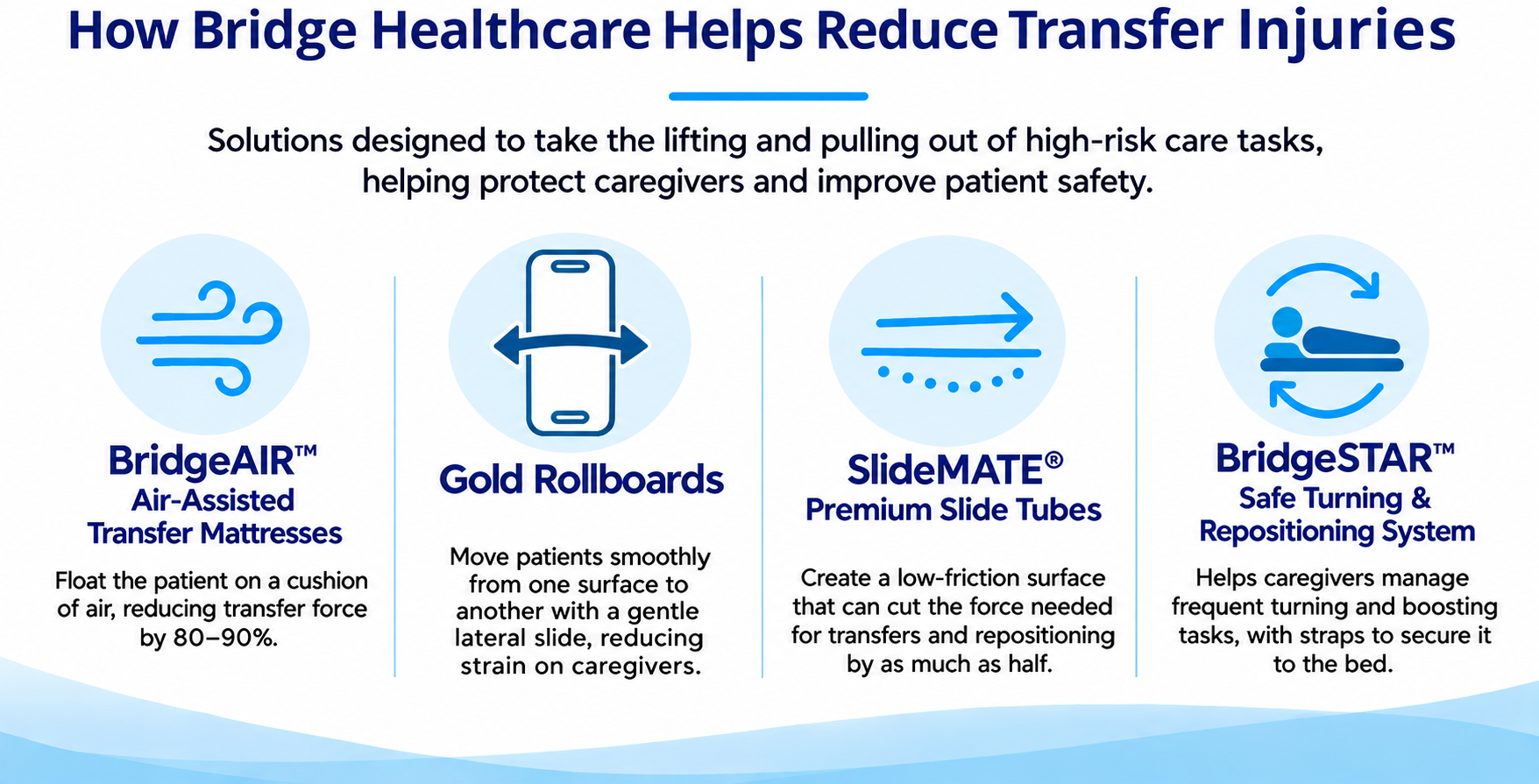
Bridge Healthcare designs patient transfer and repositioning products that take the lifting and pulling out of the tasks most likely to injure caregivers. Each product targets a specific source of strain:
- BridgeAIR™ Air-Assisted Transfer Mattresses float the patient on a cushion of air during lateral transfers, reducing the force needed to move them by 80 to 90 percent. With less pulling, caregivers put far less stress on their shoulders and lower back. The reusable mattress supports patients up to 1,200 lb and can stay under the patient between transfers.
- Gold Rollboards use a conveyor-belt design that lets staff move a patient sideways with a gentle push instead of a lift, reducing strain on the neck and shoulders. They are 75 percent lighter than metal boards, so they’re easier to carry and position.
- SlideMATE™ Premium Slide Tubes create a low-friction surface that can cut the force needed for transfers and repositioning by as much as half, helping prevent the pulling injuries that damage the rotator cuff.
- BridgeSTAR™ Safe Turning & Repositioning System helps caregivers manage frequent turning and boosting tasks. It can remain under the patient to support turning schedules and includes straps to secure it to the bed.
Beyond equipment, Bridge Healthcare’s B-SAFE clinical support helps facilities match the right products to each department and patient population. To learn which Bridge Healthcare products fit your safe patient handling program, bridgehcusa.com