

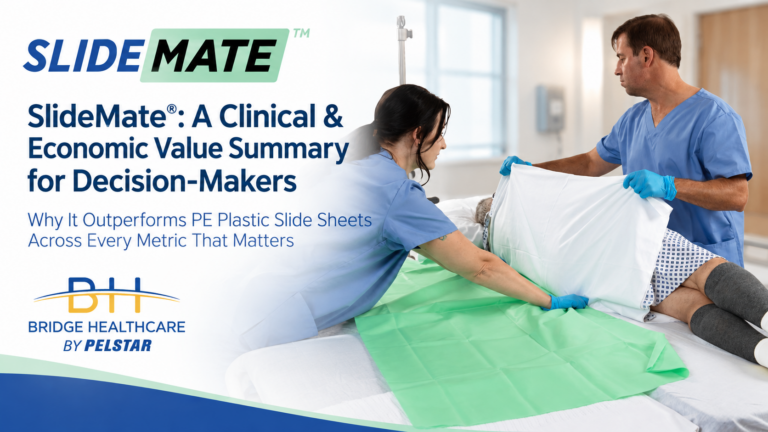
At a Glance
- >50% force reduction vs. draw sheet (Bridge Force Study, 2021)
- 43% caregiver injury reduction (two peer-reviewed studies)
- $64K–$113K average cost of one caregiver injury (NCCI / ChicagoRisk)
- 1 per stay: SlideMate® 2–4 PE sheets per patient stay
1. The Core Problem with PE Plastic Slide Sheets
Polyethylene (PE) plastic slide sheets are widely used because they are inexpensive per unit. However, the clinical and operational reality is more complex. Facilities that rely on PE plastic sheets routinely experience poor staff compliance, elevated injury rates, and higher per-patient supply consumption, all of which offset the apparent cost advantage.
What PE Plastic Slide Sheets Are — and What They Are Not
PE slide sheets are manufactured from non-woven polyethylene film, essentially a thin, smooth plastic similar in material to a standard garbage bag. They are single-direction and become less effective when wet or subjected to repeated repositioning movements. The material properties that make them inexpensive also limit their clinical utility:
Limited friction reduction in practice. Force testing demonstrated that a 198 lb patient required 37.5–46.1 lbs of maximum force to transfer using PE slide sheets — comparable to a standard draw sheet (37.6 lbs). The friction reduction PE material claims to provide does not translate to meaningful force reduction at the point of care.
Single-direction only. PE sheets are effective only for lateral transfers. Repositioning a patient up in bed — a frequent, high-injury-risk task — requires staff to remove the sheet and revert to manual technique, creating a gap in protection at one of the most common moments of injury.
Prone to tearing and degradation. PE film tears under patient weight and repeated movement. Facilities commonly use 2–4 PE sheets per patient to replace damaged units, offsetting the cost-per-use advantage significantly.
Low staff compliance. Because PE sheets don’t meaningfully reduce effort, staff frequently abandon them mid-encounter or stop using them altogether. A product that sits in a drawer provides no injury prevention benefit regardless of its unit cost.
The true cost of a PE plastic slide sheet is not its unit price. It is the number of units consumed per patient, and the injury cost it generates when staff stop using it.
2. What Makes SlideMate® Different
The SlideMate® is a premium woven polyester taffeta single-patient-use slide sheet, fundamentally different in construction from PE plastic, and measurably better in clinical outcomes.
Material & Construction
- Woven polyester taffeta fabric with a silicone-based coating provides low-friction performance that is mechanically superior to PE film, particularly under patient body weight and repeated movement.
- The woven structure resists tearing and maintains integrity through the full range of transfer and repositioning tasks a patient may require during a stay.
- Soft, comfortable surface contact improves patient experience and reduces reluctance to using the device, directly supporting staff compliance and patient cooperation.
Multi-Directional Functionality
This is one of the most clinically significant differences between SlideMate® and any PE slide sheet. SlideMate® supports:
- Lateral transfers: bed to stretcher, stretcher to OR table, and any similar horizontal movement.
- Repositioning up in bed: one of the highest-risk staff tasks in patient handling, typically performed manually when PE sheets are in use.
- Turning and positioning: for pressure injury prevention, post-surgical positioning, and comfort care.
Because the SlideMate® is multi-directional, staff can complete a full episode of care, lateral transfer, and repositioning without switching devices. This closes the injury gap that PE sheets leave open.
Single Patient Use Design
SlideMate® is designed to be placed at admission and remain with the patient for the duration of their stay. This single-unit model provides several advantages:
- Eliminates repeated supply pulls. Staff do not need to retrieve a new sheet for each transfer. The device is always present and ready.
- Reduces per-patient supply consumption. Facilities using PE sheets may go through 2–4 sheets per patient stay (due to tearing and replacement); SlideMate® requires one unit per admission.
- Supports infection control. Single-patient-use design eliminates cross-contamination risk associated with reusable or multi-patient devices.
Size Variety for Every Patient and Care Setting
SlideMate® is available in multiple sizes, providing clinicians with the appropriate product for the patient and care setting:
- Standard size for routine lateral transfers and repositioning across general care, med-surg, and step-down units.
- Bariatric/large size for heavier patients requiring additional coverage and surface area during transfers.
- Short/half-body size for targeted repositioning tasks, upper-body positioning, and scenarios when a full sheet is unnecessary.
This size range gives staff a clinically appropriate option for every patient, reducing improvisation, improving compliance, and ensuring the correct product is used for the clinical task.
3. Clinical Evidence: Force Study Results
Bridge Healthcare conducted a controlled force study (DOC.BH1STR, April 2021) to measure the actual force required to perform a lateral transfer using SlideMate® compared to a standard draw sheet and three leading PE plastic slide sheet competitors. All tests were conducted on a 198 lb patient. Each condition was tested three times; maximum and average forces were recorded.
Up to 63% less force required — and still 2.1x less force than the best-performing PE competitor.
Force required per device (198 lb patient)
- Draw Sheet + PE Slide Board (baseline): max force 167.3 N (37.6 lbs); average force 27.0 lbs
- PE Slide Sheet Competitor 1: max force 166.6 N (37.5 lbs); average force 34.5 lbs
- PE Slide Sheet Competitor 2: max force 181.6 N (40.8 lbs); average force 38.2 lbs
- PE Slide Sheet Competitor 3: max force 205.0 N (46.1 lbs); average force 44.4 lbs
- SlideMate® Slide Sheets: max force 79.3 N (17.8 lbs); average force 16.5 lbs
Source: Bridge Healthcare Clinical Data Report DOC.BH1STR, April 2021. Testing conducted with calibrated force gauge on a 198 lb patient across three trials per device.
- Less Strain: reduces caregiver exertion and fatigue.
- Safer Transfers: minimizes risk for both caregiver and patient.
- Proven Performance: clinically tested; consistently lower force across all trials.
Why This Matters to Supply Chain
Force reduction is not an abstract clinical metric. It is the mechanism through which musculoskeletal injuries are prevented. Every additional pound of force a staff member exerts during a transfer is cumulative strain on the lumbar spine, shoulders, and wrists. A product that requires 2.6x more force than its alternative is a product that generates injuries, and the financial consequences that follow.
4. Compliance: Why Better Performance = Fewer Injuries
The most important difference between SlideMate® and PE slide sheets is not what the product can do on a test bench — it’s what staff can actually do with it at the bedside. Clinical evidence and field experience consistently show the same pattern: staff use SlideMate® because it works, and they stop using PE sheets because they don’t.
The Compliance-Injury Connection
A slide sheet that is not used provides zero injury prevention benefit. Compliance is not a soft metric. It is the primary driver of whether a safe patient handling investment produces measurable injury reduction. The factors that determine compliance are:
- Perceived effectiveness. Staff who find that a device meaningfully reduces the effort of a transfer will continue using it. Staff who feel no difference will abandon it.
- Task coverage. If a device only covers one of several high-risk tasks (lateral transfer but not repositioning), staff must switch tools mid-task, reducing the likelihood that the product remains in use.
- Availability and convenience. Because the SlideMate® remains with the patient for the duration of their stay, it is always present when a transfer or repositioning task arises — removing a key barrier to consistent use and eliminating the need to retrieve a new sheet for each task.
Published Evidence on Injury Reduction
- Slide sheets reduce body friction by ~65% compared to standard transfers. Source: National Library of Medicine (Theou study, electromyography measurement)
- SlideMate® use reduces caregiver injury rate by up to 43%. Source: Workplace Health & Safety + American Journal of Occupational Therapy (two independent peer-reviewed studies)
- Caregiver injury rate in patient handling: ~4% annually. Source: ChicagoRisk / NCCI data
- Nursing assistants account for 5.3% of all workers’ comp claims exceeding $1M. Source: NCCI
- Average direct + indirect cost of one caregiver injury: $64,000–$113,000. Source: NCCI, SSA, ChicagoRisk independent analysis
5. SlideMate® vs PE Plastic Slide Sheet Comparison
Material
- PE Plastic Slide Sheet: Non-woven PE film (plastic)
- SlideMate®: Premium woven polyester taffeta with silicone coating
Maximum transfer force (198 lb patient)
- PE Plastic Slide Sheet: 5–46.1 lbs
- SlideMate®: 8 lbs
Average transfer force (198 lb patient)
- PE Plastic Slide Sheet: 5–44.4 lbs
- SlideMate®: 5 lbs
Directionality
- PE Plastic Slide Sheet: Lateral transfer only
- SlideMate®: Lateral transfer, repositioning up in bed, turning, and positioning
Durability
- PE Plastic Slide Sheet: Prone to tearing; 2–4 units often used per patient
- SlideMate®: Maintains integrity for entire length of patient stay
Units per Patient Stay
- PE Plastic Slide Sheet: 2–4 (tearing/replacement)
- SlideMate®: 1
Staff Compliance
- PE Plastic Slide Sheet: Low — minimal force reduction leads to abandonment
- SlideMate®: High — measurable force reduction drives consistent use
Patient Comfort
- PE Plastic Slide Sheet: Hard, uncomfortable plastic surface
- SlideMate®: Soft, woven, patient-friendly fabric
Infection Control
- PE Plastic Slide Sheet: Single-use, but frequently replaced mid-stay
- SlideMate®: Single-use for full patient stay, no cross-contamination risk
Size Options
- PE Plastic Slide Sheet: Average 1 size
- SlideMate®: Multiple sizes: standard, bariatric & short
Injury Prevention Efficacy
- PE Plastic Slide Sheet: Limited by low compliance and high force requirements
- SlideMate®: Up to 43% caregiver injury reduction (peer-reviewed)
6. Total Cost of Ownership: A More Complete Picture
Supply chain decisions made on unit price alone routinely miss the factors that determine actual cost. The following framework applies specifically to the PE vs SlideMate® decision.
Per Patient Supply Cost
A PE slide sheet may carry a lower unit price, but if 2–4 units are consumed per patient due to tearing and replacement, the effective cost per patient approaches or exceeds the SlideMate® cost for a single full-stay unit. The real difference is:
Supply Cost
- PE Plastic Slide Sheet: Higher supply cost per patient (2–4 units)
- SlideMate®: One unit per patient stay
Injury Risk
- PE Plastic Slide Sheet: Higher injury risk: ~20 injuries/year probability per 500 caregivers
- SlideMate®: Fewer injuries: ~11 injuries/year probability per 500 caregivers
Compliance
- PE Plastic Slide Sheet: Low staff compliance
- SlideMate®: High staff compliance
Sizing
- PE Plastic Slide Sheet: One size
- SlideMate®: Multiple size options to fit multiple care settings
$576,000+ in avoided annual injury costs (at $64,000 per injury, conservative estimate). At 500 caregivers and a 4% annual injury rate, moving from PE Slide Sheets to SlideMate® is projected to prevent ~9 injuries per year.
7. Implementation: What the Transition Looks Like
Transitioning from PE plastic slide sheets to SlideMate® does not require a protocol overhaul. Bridge Healthcare provides clinical and operational support to ensure a smooth implementation:
- Current State Assessment: Bridge reviews current slide sheet usage by department, volume, and patient population to establish a baseline.
- Product Sizing: Bridge matches SlideMate sizes to your departmental patient mix and transfer needs.
- Clinical Education: Bridge Clinical Specialists train nursing staff on SlideMate® technique, multi-directional use, and full-stay placement protocol.
- Point-of-Care Deployment: Bridge ensures SlideMate is stocked in wall dispensers and accessible at the point of care from day one.
- 30-day Utilization Review: Bridge Clinical Team checks in to confirm compliance, address questions, and document outcomes..
Learn More About SlideMates https://bridgehcusa.com/safe-patient-handling/slidemate-single-patient-use-slide-tubes/
Sources available upon request.