

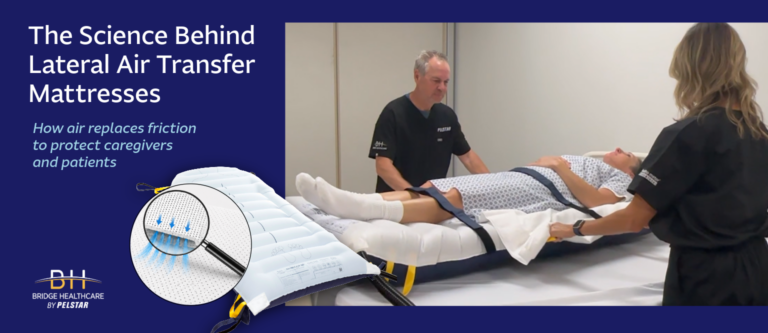
The Science Behind Lateral Air Transfer Mattresses
Safe patient handling is one of the most physically demanding — and injury-prone — aspects of healthcare work. Every day, nurses and care aides are asked to move, reposition, and transfer patients who may weigh well over 200 pounds, often in tight spaces and under time pressure. The result? Musculoskeletal injuries are among the leading causes of lost workdays in healthcare settings worldwide.
Lateral air transfer mattresses were developed to solve exactly this problem. To understand why it works so well, it helps to understand the science behind it.
The Problem: Friction and the Physics of Moving a Human Body
When a caregiver attempts to slide a patient across a bed or onto a stretcher, they are working against static friction — the resistance force that holds two surfaces together when they are at rest. The heavier the patient, the greater the normal force pressing the body into the mattress, and the greater the friction that must be overcome to initiate movement.
A patient lying on a standard hospital mattress generates enormous friction with the surface beneath them. Even with a draw sheet, caregivers must exert substantial pull forces — forces that, repeated over a shift and over a career, cause cumulative damage to backs, shoulders, and wrists.
Lateral transfers — moving a patient sideways from a bed to a stretcher, or repositioning them to prevent pressure injuries — are particularly hazardous because the force must be applied horizontally, often requiring the caregiver to bend and twist simultaneously.
The Solution: Replacing Friction with Air
The science behind lateral air transfer technology is relatively simple: if you introduce a thin, pressurized layer of air between the mattress and the surface it rests on, you effectively eliminate surface-to-surface contact. Instead of dragging against fabric or foam, the mattress glides across a fluid medium — air — which has almost no resistance to lateral movement. This is the same principle that allows air hockey pucks to glide effortlessly across a table.
Here is how the system works in clinical practice:
Pressurized Airflow – An external air blower pumps a continuous, pressurized stream of air into the mattress placed beneath the patient.
Perforated Air Ports – The underside of the mattress is engineered with tiny, precisely sized holes distributed across its surface. These perforations are small enough to maintain pressure within the mattress while allowing a controlled amount of air to escape downward.
The Air Cushion – As air is forced out through the bottom of the mattress, it creates a thin, pressurized layer, an air film, between the mattress and the bed or stretcher surface beneath it. The patient and mattress are, in effect, “floating.”
Friction Elimination – Because the mattress contact with the underlying surface is greatly reduced, the coefficient of friction and surface drag drops dramatically. The caregiver is not fighting the patient’s weight, they are simply guiding a floating load.
Why Moving a Patient Takes 80–90% Less Effort
Think about sliding a heavy piece of furniture across the floor. It takes significant force to get it moving, and continued effort to keep it going, because the weight of the object creates resistance the entire time. The same is true when caregivers manually transfer a patient: body weight presses down into the mattress, generating friction that staff must physically overcome with every move.
When the air mattress inflates, that friction essentially disappears. The pressurized air cushion beneath the mattress separates it from the underlying surface, eliminating the direct contact that causes drag. Instead of fighting against the patient’s weight, caregivers are simply guiding a load that is already floating.
The practical result is a reduction in pull/push force of up to 80–90%. A transfer that might normally require three or four caregivers can be handled by one or two — with far less physical strain.
BridgeAir™ is an innovative air-assisted breathable lateral transfer and repositioning mattress, purpose-designed to prioritize the well-being of caregivers, patients, and healthcare organizations simultaneously. BridgeAir™ operates on the same core air bearing principles described above, engineered to clinical-grade precision.
Conclusion
Lateral transfers and repositioning tasks are not isolated events — they happen dozens or hundreds of times per shift across a healthcare facility. The cumulative physical load on caregiving staff is substantial, and the injury statistics reflect it. Back injuries alone account for a disproportionate share of healthcare worker compensation claims and early departures from the profession.
Tools like BridgeAir™ don’t just make individual transfers easier — they change the ergonomic calculus of caregiving at scale. When every lateral transfer requires a fraction of the previous effort, the cumulative wear on staff bodies decreases. Caregivers can sustain their physical health over longer careers. Facilities see reductions in injury-related absences and associated costs.
For patients, the benefits compound across a hospital stay. Fewer forceful transfers mean less skin trauma, less pain, and greater dignity during an inherently vulnerable experience.
If you would like to learn more about BridgeAir™, visit https://bridgehcusa.com/safe-patient-handling/bridgeair. If you have any questions, please contact us at (800) 815-6615 or info@pelstarllc.com.